Like Me on Facebook

Showing posts with label knitting. Show all posts

Friday, June 20, 2014

Solar Dyeing...Let the Summer Heat Do the Work!

Looking for an interesting way to dye yarn?   This is an easy "Do It Yourself" way to dye using the heat of the sun.  Each skein will be unique, the colours will vary in each batch, and the colour will sometimes be solid or more variegated, this is not a precise colour method of dyeing.

First here is what you need:
black plastic garbage bags
large mason jars (also gallon freezer ziploc bags will work but it’s not quite as easy to fill)
citric acid or white vinegar
acid dyes
protein fibre(wool, locks, silk)
Mason Jars
large measuring cup for pouring water into jars
plastic spoon or measuring spoon for dye
wooden skewers


Once you have everything ready....start with filling a couple large dye pots with water and a few tablespoons of citric acid then bring to a boil.  Measure out your fibre, usually 2-4 oz bundles is a good size(to fit in a mason jar) and soak these bundles in water.

Dyes


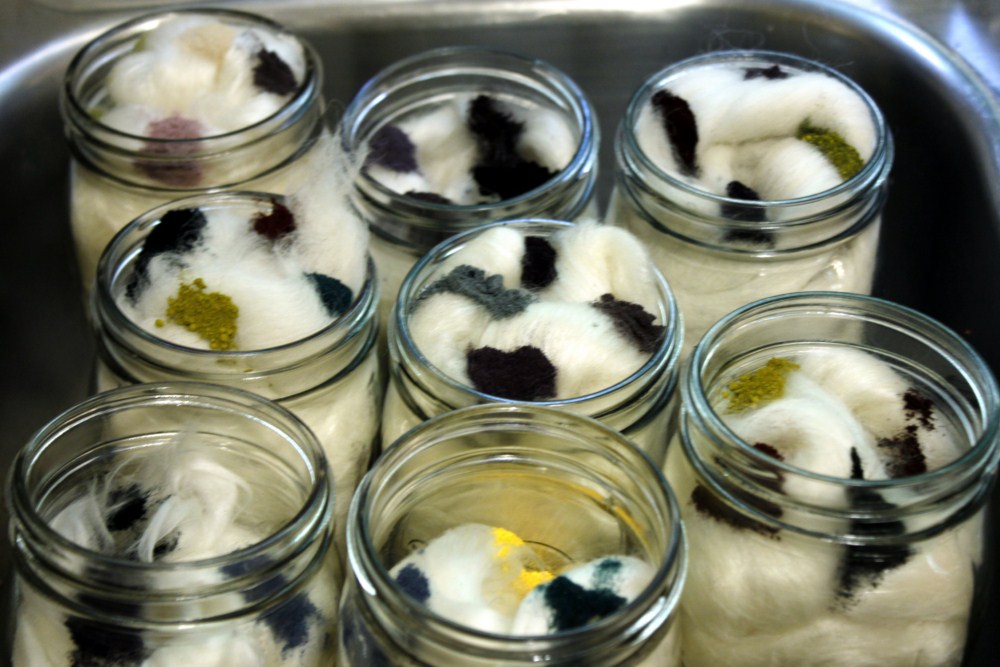
Next add dye to your  mason jars and then add your 2-4 oz. bundle of either wool or locks...again amount will depend on the thickness of the fibre you are using, i.e. you could put more silk in a jar than wool.  Adjust your dye to the "bulk" of your fibre.

Dyes with Jars


Once the jar is filled with fibre pour the boiling water into the jars.  Using a measuring cup adds in your accuracy of getting the liquid into the jars.  Fill the jar about a 3/4 of the way (it will depend on how much fibre you have in the jar...so a bit more or less).  Once that has been done...push the bundle down using a skewer, if there is room at the top add more of your citric acid solution.
Yarn Solar Dyeing


Mason Jars filled with Yarn Solar Dyeing

Now put the lids on the jars and put the jars outside to set, do this when the sun is strongest!.  Put the jars in an area that gets the most direct sunlight.  If I need to “force” some extra heat, put a black plastic bag under the jars or if it isn't as hot as it was predicted that day you can put the jars IN a black plastic bag, and tie the top.. this will create some extra heat.
For Solar Dyeing to work you must reach at least 185 degrees F.  for at least 30 minutes...longer is better (3-4 hours). During this time the dye is adhering to the protein in the fibre.
When the dyes are set, the water-which was at first the color of your dye- will be clear, and your fiber will be dyed. Remember this technique creates a variance in colour in each skein and jar.    A way to create a tye dye look is to put your dry fibre in first then add the dye colour then more fibre more dye colour and repeat and at the end add your citric water.  The water will then filter down.
Solar Dyed Yarns

Solar Dyed Yarns Drying 
I was really pleased with how my yarns turned out!  The colours are great and it was quite simple!  I hope you find the instructions and pictures easy to follow.  I found the original article on Jazzturtle's How to Do it.

Monday, June 16, 2014

Felting, Fibre, Turkeys and Eggs

Another rainy day on the farm!  Which is good and bad....good for the gardens...bad for haying!

Rovings for spinning or felting
Today is just an update day....we have been shearing, shearing and shearing...and are almost done.  We did something a little different this time,  I kept some Alpaca fibre separate for those of you that enjoy felting.  It is something that I am quite enjoying.  You can felt in many different ways, such as Nuno felting...adding layers of fibre such as merino to silk to create a wearable items, i.e. a scarf, Needle felting, where you can create free standing objects ..animals are very common..."statues" you would almost say, Wet felting where you take wool and create sheets of felt and Resist felting where you use cardboard or plastic to create a form.  So as you see fibre doesn't just have to be made into a yarn for knitting and crocheting but it can be used in it's raw state as well to create other items.  I have both yarns and fibres.  We have Alpaca, Llama, Mohair, Merino, Wool, and Cashgora here for sale plus a few other specialty bits and pieces.

Turkeys from 2013
In other news the baby turkeys have arrived and we have more coming this week.  And although it is only June we do start to take orders for Thanksgiving as much as we don't want to rush the seasons, if you want a turkey you need to book early.  Last year we couldn't meet the demand!  Something else I want to mention and for those of you who have been here you know our turkeys when old enough get to be outside in a secure area in the sun and locked away at night.  It's a good turkey life!

We also have farm fresh eggs!  Nothing compares to farm fresh eggs!  The colour is brighter and the taste richer...enhanced.

We still have kids for sale...the boys have been wethered now.  We have a Nigora, Jake who is all black, and two Pygora/Nigerian Dwarf crosses, Louie and Jerry as well as Mick our Olde English Babydoll.

As always the store is open Thursday thru Sunday 10-5 pm or by appointment.

And don't forget if you are interested in booking a farm tour...give me a call at 705-778-2070

Friday, May 2, 2014

What is Pygora and Cashgora Yarn?

Today is a continuation in the discovery of yarns. Here at Elmlea Farms we have a variety of fibre animals and in the goat department we have, Cashmere, Nigerian, Angora and a few crosses...Pygora(that's a Pygmy and an Angora cross)and the Cashgora is a(Cashmere/Angora cross) and currently Nigora(Nigerian/Angora cross)

The Pygora is a relatively new breed developed by Katherine Jorgensen of Oregon. Aiming for an animal that would yield a fine spinning fiber, she crossed a registered Pygmy goat with a registered silky-fleeced Angora goat. This mating produced F-1 generation hybrids, which when bred together resulted in the true Pygora. The Pygora Breeders Association (PBA) organized in 1987, and according to the association, the breed’s popularity has steadily increased since that time.  The name Cashgora was coined in the late 1970's in Victoria, Australia and later came to be recognized by the International World Textile Organization in 1988.  The Nigora is a medium sized, dual-purpose milk fibre goat.  It originated in the USA in the early 1990's.  Early Nigoras contained a mixture of Nigerian Dwarf and a coloured Angora goats.  Jill(Nigerian) bred to Omar(Angora) has given us two babies a male and female pure black.  We are excited to see what their fibre will be!  Neither Pygora, Cashgora or Nigora are used to produce yarn on a commerical scale.  We however do produce these fibres, excluding Nigora at this time.

The wool of the Cashgora combines the advantages of both Mohair and Angora, while maintaining softness, brightness and shine.

 "The fiber of Pygora goats reflects the best qualities of both the Angora and the Pygmy. From the Angora goat comes long, silky-smooth, lustrous ringlets. The Pygmy goat contributes its’ very fine down, in some cases fine enough to be classified as cashmere. This combination of qualities results in fiber with an excellent range of characteristics that maintain fineness as the animal ages.

Pygora fiber may be spun and then knitted, woven or crocheted. Because of the fineness of the fiber, it spins into a lovely yarn that is soft enough to be worn next to the skin. Items such as baby garments or luxurious shawls are well suited to Pygora yarn. Pygora also felts beautifully and locks of Pygora may be used to create wigs, beards or novelty toys. Pygora pelts make wonderfully posh rugs or chair accessories. Thus, Pygora fiber is fast becoming crafts persons’ and fiber artists’ preferred choice for any number of diverse projects". ...taken from pcagoats.org..Goat Fibre Desc. 


Come to the store and see our selection of fine yarns...Lucy may even help!
The Store is now open Thursday thru Sunday 10-5 pm.  Please feel free to drop in or call first.  We have new items and of course there are farm fresh eggs!


Friday, April 25, 2014

So ...You Think You Know Alpaca Yarn!?

Today I would like to talk about Alpaca Yarn.  It is a beautiful light weigh fibre with wonderful attributes, but there are some misconceptions, so to address this I am posting an article from "Knit Picks" that gives a nice brief history on the animals and on the fibre/yarn.
In the article it talks about blending the yarn for larger scaled knitted items.  The store offers you all that is needed to start knitting, from knitting needles to Alpaca, Merino, Mohair yarns.

The Elmlea Farm Store reopens on May 1st, 2014!  If you would like to get started on any project sooner or need fresh eggs please feel free to call me to arrange a time to drop by, the number is
705-778-2070.
Enjoy your weekend!

Alpaca
Hailing from South America, the alpaca belongs to the camelid family that also includes camels, llamas, guanacos and vicunas. They are a docile breed whose fleece spins into luxurious yarns. More than three quarters of the world’s alpaca population resides in Peru.1 In centuries past, the alpaca was an incredibly valuable animal, even more so than precious gems! Clothing created with alpaca was restricted for use by royalty. The alpaca has been domesticated and is treated as one of Peru’s national treasures. England has the double decker bus, the U.S. has Mt. Rushmore, and Peru has their alpacas. What a diverse definition of treasure!
Alpaca fleece is a “protein fiber”. This doesn’t mean knitting with it will make you stronger, it merely indicates that the fiber comes from an animal- namely, the alpaca. Alpaca fiber is strong, warm, and comfortable. Each fiber is hollow which makes it incredibly lightweight. Even the most delicate alpaca garments are warm for this reason. Perhaps alpaca’s greatest feature is that it can be worn next to the skin comfortably. The explanation for this is the behavior of the scales on the exterior of the fiber itself. They all lie flat in the same direction, making for a smooth surface. Less expensive than cashmere and with the strength of mohair, alpaca is highly desirable and functional. As with most natural fibers, alpaca needs to be handled with care when it comes to water exposure. Be sure to read and heed the washing instructions on your yarn or sweater.
While there are 2 breeds of alpaca, Huacaya and Suri, the former makes up a whopping 95% of the population.2 Differences between the two are numerous and as you may have guessed from the percentages, the Suri is harder to come by. Suri qualities include fleece that grows downward like human hair in wavy or curly locks with a silky texture. Huacaya fleece is coarser and grows straight outwards, at a right angle to the skin of the alpaca.
YES SURI, BABY, YOU’RE SUPERFINE!
When alpaca fiber is processed, it is evaluated and sorted into one of several categories based on its micron count (in layman’s terms: the softness quotient). Micron count is a technical measurement determined by studying a sample of alpaca fleece and calculating the average diameter of the shaft of each fiber. Baby alpaca might have a micron count in the high teens whereas superfine alpaca would fall in the mid-twenties. The lower the number, the finer the fiber. *Please note that baby alpaca is a classification group, meaning it doesn’t always come from young alpacas. It merely refers to any fibers from an alpaca’s fleece that fall within said micron count. While fibers become coarser as an alpaca ages, it is possible for older alpacas to continue to produce fibers that fall in the baby alpaca micron count range.
Yarn Classification
Average Micron Count
Average Fiber Length
Baby (finest)
21-23
>=64mm. (2½ in.)
Superfine
25-26.5
>=65mm. (2½ in.)
Suri
26-27
>=68mm. (2¾ in.)
Yarns sold by Knit Picks fall within these measurements.
If all of this jargon confuses you, then you might relate better to the methods used by Peruvian women who hand sort all of the fibers and determine their classification based on how they actually feel.3 The finest and softest feeling fibers are tagged as baby alpaca, and so on for fine and superfine yarns. Fiber from various parts of the animal can have different feels.
SMOOTH OPERATOR
Knitted garments made of alpaca have some interesting properties. You should know that alpaca yarn is pretty stubborn when it comes to elasticity. It’s not that it won’t give, it actually has a tendency to be too generous. If you knit dense stitches and patterns or hang heavy embellishments on it, it will become distorted with no hopes of regaining its youthful figure. This is due to the aforementioned smoothness of the fibers. Since the scales lie flat in the same direction, the plies or strands of an alpaca yarn slide past each other instead of clinging and gravity can take its toll on the fabric. Gravity, as we know, can sometimes cause an undesirable elongating effect. So make those 100% alpaca projects light and airy, or use a blend for greater resilience and elasticity.
Speaking of which, all blends happen for a reason. There are ways to make alpaca yarn work for every project and that is by blending it with complimentary fibers. Blended yarns are not created arbitrarily. Wool, for instance, is a highly crimped fiber and therefore offers some elasticity. Since alpaca fibers contain only shallow waves, mixing in some wool makes an otherwise unyielding yarn a little more forgiving.

1“A Shaggy Business” The Economist. Vol. 377, Issue 8455, p. 38. 12/3/2005.
2Quiggle, Charlotte. “Alpaca: An Ancient Luxury” Interweave Knits. Fall 2000.
3Lavan, Cindy. “Evaluating Alpaca Fleece” AlpacaNation – Alpaca Industry’s Central Marketplace. June 2002. http://www.alpacanation.com/articles/AlpacaFuture_Oct02.asp

Monday, March 24, 2014

Spring Cleaning Elmlea Farm Store

Spring Cleaning has started in the store!

I am hopeful to have the store back to it's regular hours soon!  With the constant snow we have been closed except for anyone who has made an appointment to drop by.   The number to reach us is 
705-778-2070.  

While getting things ready I thought I would show case something I didn't make along with some of my yarns .  We do care a few items by other local artisans.  Here are a few silk scarves we have, they come in two lengths.  Aren't the colours beautiful?  
Silk Scarves


While admiring these scarves, I realized I have yarns that a very similar!  We tend to think of knitting as a "winter" hobby, but don't forget how often we grab for a light sweater or shawl in the spring and summer!  These yarns and colours would make lovely shawls or sweaters.  And remember you can mix your yarn, not only mixing Alpaca with a blend but also mix your colours for more versatility. A solid with just a bit of colour spices everything up, without going over board.

Thursday, December 2, 2010

SNAP Northumberland West - The Fibre Artists Collective Show & Sale

Well Christmas is getting closer,so trying to keep up with the demand is getting to be more fun all the time.
We'll be in Lyndsay at the Armory on Dec.11 and 18 at the craft sale.
Our sale in Port Hope was quiet but the people that came out were very appreciative of the quality of items at the tables.
You can still buy gifts from any of the artists by contacting them or me.
I've posted a story and some pics of that day.

SNAP Northumberland West - The Fibre Artists Collective Show & Sale

Sunday, October 18, 2009

Craftworks and flat I-cord


Well Thanksgiving is over. The Norwood Fair was a busy pl;ace in spite of the cold. Our 15 minutes of fame on CHEX TV went well.
We now have our product at Craftworks in Peterborough(www.peterboroughcraftworks.com/). The booth looks good and the building has been really well renovated.
I've found a quick and easy method for knitting scarves. You use flat I-cord(knit one,purl two, knit one),when the cord is as long as you want your scarf to be,take a med. size crochet hook and crochet two rows of double crochet around the I-cord. At the corners crochet a double crochet,one single crochet and then another double crochet into each corner to square them off.
I've also been busy taking some of the neutral Alpaca yarn and Mohair and dyeing them with food colouring to create some accent yarns for the scarves and mitts.

Friday, July 10, 2009

Still haven't got the fleece sorted for the mill,but I think the house in Eganville has been sold and we did get the first hay in without any rain.
My grandkids will be here Sunday until Friday. Yippee!!!!!
Still waiting for two more cria,I can't understand why they all need to wait the full year. I'll post pics when they're all hear.
I need to look for a good fingerless mitts pattern to knit. I'm almost finished my first hand spun,hand dyed knit scarf.