Like Me on Facebook

Showing posts with label yarn. Show all posts

Monday, August 4, 2014

Something Older, Something New

 It's been a few weeks since our last blog...you'd think we were on holidays or something!  Not the case just busy and getting busier...gardens are growing, baby chickens, turkeys and ducklings are growing, alpaca baby growing...speaking of which the baby is a boy not a girl as first announced. And we have new product arriving,  hence the title of "older and new".  I will be showing and telling you things in the next weeks, regarding new arrivals and upcoming events.  But today I am featuring our authentic barn boards and our newly arrived handcrafted yarn bowls!
Barn Boards and Various Baskets


Motifs and Plain Authentic Barn Boards


Yarn Bowl
These bowls are not only practical but gorgeous pieces of pottery!  Designed to hold your ball of yarn, keeping it clean with easy access ...they certainly could be used to "hold" for other items.  I personally think it will be a great base for a gift basket!  These bowls are locally crafted and are for sale at our store for only $ 30.00.
Yarn Bowl

Various designs of Yarn Bowls


Yarn Bowl with Yarn
As always the store is open Thursday thru Sunday 10-5 pm.  Come in and see our selection of natural fibres and handcrafted items as well we have farm fresh eggs and local meats.

Wednesday, July 9, 2014

A Brief Peek at a Farm Tour...part 1

Good Wednesday Morning!  I'm late with this week's blog!  BUT....for a very good reason....we hosted a farm tour on Monday and what a GREAT time! 

While the weather was iffy at first, it turned out to be a wonderful day.  We had our sun shelters up, there was tea and coffee when things were a bit dreary to warm you up and of course a good selection of cold drinks.

We were able to shear a Llama and Snowflake was very happy to oblige and have her huge "blanket" removed....much cooler now!  She even had a pedicure!

Llama Fibre
Patrick and Lucy along with all the other sheep and goats entertained the crowd and Patrick was very insistent on getting his head petted.  Timo was our Alpaca ambassador and he came out to give kiss and smell everyone's hair!  He's a cutie.

Lucy and her son Jerry
Elmer gave an explanation of the various kinds of Sheep, Goats, Alpacas and Llamas and even showed the chickens and turkeys and ducks of various shapes and sizes and farm fresh eggs were greatly in demand!
"Scrappy"
Then it was on to the REAL purpose of this farm, the fibre....how fibre is processed....Lee took everyone through a full demonstration, the raw fibre...shearing, picking, combing, carting and spinning!   She makes everything look so easy! 

The store offers a great variety of fibre, alpaca, wool, mohair, blends of each and beautiful vibrant colours!  The solar dyed yarns were a real hit!
Store fibres

I will be posting pictures on Monday going through the steps.  Our group arrived at 10:30am and left at 3pm.  While we provided the drinks they brought their own lunch.

If you think you might be interested in having a group tour of the farm and the store just let us know.  Reach us at 705-778-2070 or email elmleaalpacas@gmail.com.  The cost is $20.00 per person.  We can slightly tailor the even to your needs...but keep in mind that we are NOT a petting farm and while Patrick and some others love the attention, most of the animals are farm animals.  Another point of interest is being a FIBRE farm means we are NOT eating these goats and sheep...or Alpacas!  The purpose of our farm is to use the fibre from these animals is various ways whether through creating yarns for knitting and crocheting or for using the fibre in felting.

BUT our farm store does sell lamb, goat, and beef (supplied by local farms)along with chicken, turkey and eggs.  If you are looking for your Thanksgiving Turkey you need to order it soon! 

Store is open Thursday thru Sunday 10 am to 5 pm!  Come say "Hi"!

Monday, June 23, 2014

Knitting Machines: The Good, The Bad and The Ugly

The Knitting Machine...Part 1


I love my knitting machine, I hate my knitting machine, I realize this every time I go to use it.

The Good:  I can knit a pair of mitts in less than 2 hours, a shawl in about the same amount of time and use beautiful lace stitches.

The Bad:  When getting into rhythm half a dozen stitches fall off and you create a loop at both ends.

The Ugly:  Creating a garment too big or too small or trying to ensure that the scarf made with Alpaca and/or Mohair doesn’t have totally curled edges.

There are three kinds of machines:   1. Fine or Standard has needles 4.5mm apart  2. Mid- Gauge has 6.5mm needles 3. Chunky or Bulky has 9mm needles.  These names refer to the weight of yarn that you can knit with them.
Double Bed Singer Bulky

Single Bed Brother Bulky

There are single bed machines which knit flat pieces and double bed machines also called main bed and ribber which will knit tubular pieces.  There are also manual, punch card and electronic machines. You can get Intarsia carriages for some models and Lace carriages for some.
The most common names under which knitting machines are sold are Passap (no longer in business), Singer, Brother (the easiest to get parts for) Bond, SilverReed (still producing a limited number of models)
People seem to think if you use a knitting machine it’s not as personal as hand knitting.  Knitting with a machine does not mean you are only moving a carriage across a bed over and over again without any thought.  One of the main reasons people stopped using the knitting machine is due to the precision required to actually produce a garment.  There is much hands on work required besides moving the carriage, you must cast on your stitches, track your rows, decrease or increase stitches by hand.  Then there is the planning of the piece, making a swatch, choosing a pattern, the yarn and then working to produce a good looking, well finished piece that fits the recipient. This is just as much of a personal journey as any hand knitting piece I have made.

Machine knitting has a place in the fibre spectrum and I seem to surprise myself with its endless possibilities every time I sit down to use one (I have 4) of my machines!

Friday, June 20, 2014

Solar Dyeing...Let the Summer Heat Do the Work!

Looking for an interesting way to dye yarn?   This is an easy "Do It Yourself" way to dye using the heat of the sun.  Each skein will be unique, the colours will vary in each batch, and the colour will sometimes be solid or more variegated, this is not a precise colour method of dyeing.

First here is what you need:
black plastic garbage bags
large mason jars (also gallon freezer ziploc bags will work but it’s not quite as easy to fill)
citric acid or white vinegar
acid dyes
protein fibre(wool, locks, silk)
Mason Jars
large measuring cup for pouring water into jars
plastic spoon or measuring spoon for dye
wooden skewers


Once you have everything ready....start with filling a couple large dye pots with water and a few tablespoons of citric acid then bring to a boil.  Measure out your fibre, usually 2-4 oz bundles is a good size(to fit in a mason jar) and soak these bundles in water.

Dyes


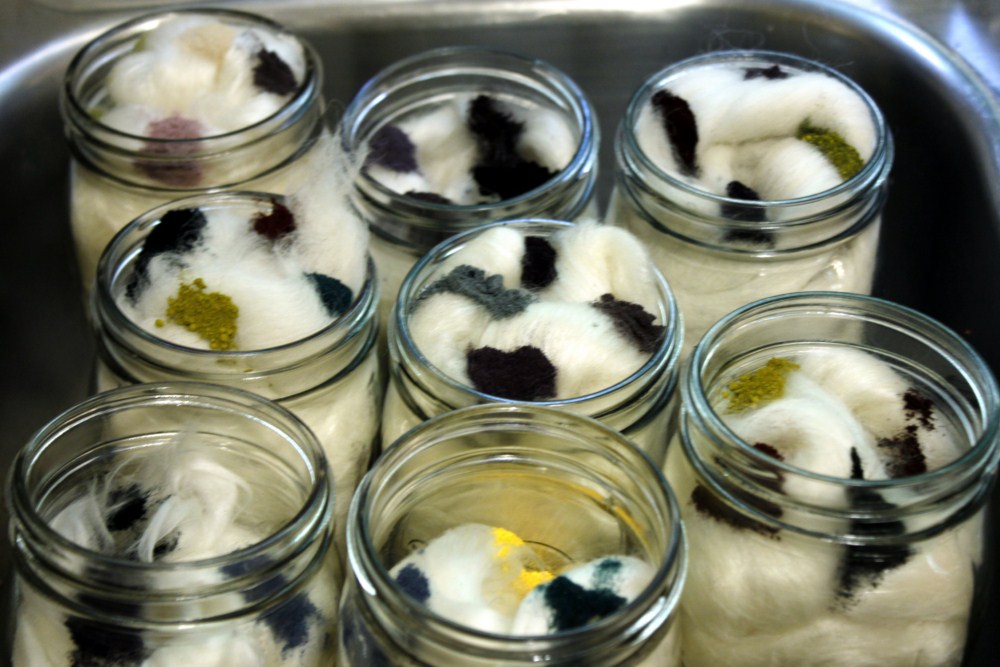
Next add dye to your  mason jars and then add your 2-4 oz. bundle of either wool or locks...again amount will depend on the thickness of the fibre you are using, i.e. you could put more silk in a jar than wool.  Adjust your dye to the "bulk" of your fibre.

Dyes with Jars


Once the jar is filled with fibre pour the boiling water into the jars.  Using a measuring cup adds in your accuracy of getting the liquid into the jars.  Fill the jar about a 3/4 of the way (it will depend on how much fibre you have in the jar...so a bit more or less).  Once that has been done...push the bundle down using a skewer, if there is room at the top add more of your citric acid solution.
Yarn Solar Dyeing


Mason Jars filled with Yarn Solar Dyeing

Now put the lids on the jars and put the jars outside to set, do this when the sun is strongest!.  Put the jars in an area that gets the most direct sunlight.  If I need to “force” some extra heat, put a black plastic bag under the jars or if it isn't as hot as it was predicted that day you can put the jars IN a black plastic bag, and tie the top.. this will create some extra heat.
For Solar Dyeing to work you must reach at least 185 degrees F.  for at least 30 minutes...longer is better (3-4 hours). During this time the dye is adhering to the protein in the fibre.
When the dyes are set, the water-which was at first the color of your dye- will be clear, and your fiber will be dyed. Remember this technique creates a variance in colour in each skein and jar.    A way to create a tye dye look is to put your dry fibre in first then add the dye colour then more fibre more dye colour and repeat and at the end add your citric water.  The water will then filter down.
Solar Dyed Yarns

Solar Dyed Yarns Drying 
I was really pleased with how my yarns turned out!  The colours are great and it was quite simple!  I hope you find the instructions and pictures easy to follow.  I found the original article on Jazzturtle's How to Do it.

Monday, June 9, 2014

Group Farm Tour Available

Over the past months I have shown you a number of our animals, fibre processes and our product.  I hope you have enjoyed the pictures.....but have you ever thought about getting a group together and meeting the animals and seeing how the process is done first hand?

Store 2014
We can accommodates a fair size group ..you can participate too if you like,  doing things such as carting fibre.  Remember it is a farm, the animals are not pets per say...HOWEVER.. there are some animals here, sheep, goats. alpacas, llamas and even chickens...who would just love to say HI!  And if you have a camera.....some....Lucy, Patrick...are camera hogs!
Goats

We would provide you with a range of beverages, water, tea, coffee, and a scenic spot for you to eat any lunch or snacks you have brought.  The cost is $ 20.00 per person.

Chickens
After you have toured the farm, met the animals and seen how yarn is made you can check out the store and see if anything strikes your fancy.....and you could even buy a dozen farm fresh eggs!  And YES they do taste better!
Alpaca

Any questions just give us a call at 705-778-2070.  The store is open to the public Thursday thru Sunday 10 am - 5 pm, or by appointment.

Have a great week and now...for me it's haying time!
Olde English Babydoll Southdown

Friday, May 23, 2014

Just one more thing.....

A short week over.....although in farming there are really no short weeks...or weekends....actually that is a lie...weekends mean MORE work!


Today I just have two notes...one...I am very excited that our new yarns will be arriving on Monday!  These yarns are processed from our own Alpacas and Goats.  As you know I do process some of the fibre right here on the farm but we also send some out.  I will have nature colour Alpaca yarn and a nice blend of Alpaca and Mohair in lovely colours!  I can't wait!  You will have to drop in next week to see!


And secondly "Baby Mick" needs to find a home.  Mick is  black registered Olde English Babydoll Southdown lamb.  Babydolls are smaller than most sheep growing to a height if 17-24 inches.  They are stocky and hardy but their miniature size makes them easier to handle!  They are great nature mowers, weeders and heck they will even fertilize and they go!
Now besides that Babydolls are sweet in nature and are great companion animals and you can use the wool!  So any of you knitters or spinners out their their wool is great to use alone or to blend!  We are asking $ 600.00 for Mick.  Please feel free to drop by and see him and his parents Inky and Liz. 


Don't forget the store is open Thursday thru Sunday 10-5 pm.  We take Visa and M/C and of course cash.


Drop by and see us this weekend or next week! 

Friday, May 2, 2014

What is Pygora and Cashgora Yarn?

Today is a continuation in the discovery of yarns. Here at Elmlea Farms we have a variety of fibre animals and in the goat department we have, Cashmere, Nigerian, Angora and a few crosses...Pygora(that's a Pygmy and an Angora cross)and the Cashgora is a(Cashmere/Angora cross) and currently Nigora(Nigerian/Angora cross)

The Pygora is a relatively new breed developed by Katherine Jorgensen of Oregon. Aiming for an animal that would yield a fine spinning fiber, she crossed a registered Pygmy goat with a registered silky-fleeced Angora goat. This mating produced F-1 generation hybrids, which when bred together resulted in the true Pygora. The Pygora Breeders Association (PBA) organized in 1987, and according to the association, the breed’s popularity has steadily increased since that time.  The name Cashgora was coined in the late 1970's in Victoria, Australia and later came to be recognized by the International World Textile Organization in 1988.  The Nigora is a medium sized, dual-purpose milk fibre goat.  It originated in the USA in the early 1990's.  Early Nigoras contained a mixture of Nigerian Dwarf and a coloured Angora goats.  Jill(Nigerian) bred to Omar(Angora) has given us two babies a male and female pure black.  We are excited to see what their fibre will be!  Neither Pygora, Cashgora or Nigora are used to produce yarn on a commerical scale.  We however do produce these fibres, excluding Nigora at this time.

The wool of the Cashgora combines the advantages of both Mohair and Angora, while maintaining softness, brightness and shine.

 "The fiber of Pygora goats reflects the best qualities of both the Angora and the Pygmy. From the Angora goat comes long, silky-smooth, lustrous ringlets. The Pygmy goat contributes its’ very fine down, in some cases fine enough to be classified as cashmere. This combination of qualities results in fiber with an excellent range of characteristics that maintain fineness as the animal ages.

Pygora fiber may be spun and then knitted, woven or crocheted. Because of the fineness of the fiber, it spins into a lovely yarn that is soft enough to be worn next to the skin. Items such as baby garments or luxurious shawls are well suited to Pygora yarn. Pygora also felts beautifully and locks of Pygora may be used to create wigs, beards or novelty toys. Pygora pelts make wonderfully posh rugs or chair accessories. Thus, Pygora fiber is fast becoming crafts persons’ and fiber artists’ preferred choice for any number of diverse projects". ...taken from pcagoats.org..Goat Fibre Desc. 


Come to the store and see our selection of fine yarns...Lucy may even help!
The Store is now open Thursday thru Sunday 10-5 pm.  Please feel free to drop in or call first.  We have new items and of course there are farm fresh eggs!


Monday, April 28, 2014

Knitting with Mohair and Mohair Blended Yarn

Happy Monday Everyone!

As you may have noticed there has been a theme to my last few posts.  I am hoping that by "teaching" everyone a few extra things with regards to different yarns and crafts that you may want to try your hand at creating!  I am looking outside and thinking I can't wait to be able to find a few hours; later on as Spring progresses and the farm "clean up" is done and sit outside and make a few things while enjoying the warmth of the sun.  Yes I am positive we WILL have warmth...soon!

Angora Kid
Also everything that I am showing you, you can find at the store.  Today I am talking about Mohair and knitting with it.  As you may remember...Mohair starts here with an Angora Goat just like our newest member of the family, Macy!  I have Mohair and Mohair blends in a beautiful array of colours!  Remember the store re-opens May 1st but you can certainly arrange a time to stop by just by calling 705-778-2070.

Here is an article by: The Halo Effect: Tricks and Tips for Knitting with Mohair
Posted by  on Jan 27, 2014 in Knitting 
The soft halo effect that mohair yarn creates can add instant softness and elegance to any knitting project, but there are a few things to keep in mind when knitting with mohair. Here are a few mohair tips, plus a few of our favorite mohair yarns and patterns to knit.
Delicate Mohair Yarn - on Craftsy

About mohair yarns

Mohair fiber comes from the angora goat (not to be confused with the angora rabbit that produces angora fiber). You’ve probably also noticed mohair labeled as kid mohair. This mohair comes from a kid — a baby goat — and is both finer and softer.

A few things to keep in mind when working with mohair:

Drape

Mohair’s soft texture allows it to drape beautifully. Keep it in mind for wraps, scarves or any other type of accessory that calls for a luxurious, elegant drape. You’ll see many examples of this in the patterns below.

Ripping mohair

Mistakes happen and sometimes we need to rip our project. Because of the long, delicate fibers, ripping mohair can be a challenge. Be sure to rip your work out slowly, gripping the yarn as close to the work as possible when you rip.

Texture

Mohair creates a beautiful drape, so why not leave it at that? Don’t go too insane with the texture of your stitches. You don’t need to add any fancy cables or special stitches to the design because mohair is already making a statement on its own.
If you’re a fan of lace knitting, consider mohair for your next lace project. Its airy texture goes hand in hand with a lot of beautiful lace patterns.

Mohair patterns to try

Mohair is versatile enough to work well in many different kinds of knits. Check out these Craftsy patterns for inspiration and ideas for your next mohair knitting project.
Sequined knit mohair lace vest
Photo via Craftsy member irissch

Sequined mohair lace vest

Have you ever worked with Artyarns before? The sequins and beads of their mohair is already attached, so you can knit up your project without worrying about attaching them as you go. This lace vest uses just two skeins of Artyarns Beaded Mohair and Sequins for a vest that’s loose but also slightly clingy because of the mohair fibers.