Like Me on Facebook

Showing posts with label mohair. Show all posts

Monday, August 11, 2014

New Yarns and Socks in Fabulous Colours!

WOW!  The second week of August already!  Where does the time go?  The days have been nice but some of the nights are actually getting cooler I am sad to say. However, as Canadians we know that there is still lots of time left to enjoy and relax the weather and to engage in our hobbies, especially while on holidays!  So with that in mind, I have something for all you yarn crafters out there or for you who would like to get something for your crafting friends.

Our new yarn and socks have arrived and both come in great colours and yes even styles!  Styles for yarn?  Well a bit of an exaggeration but we just got in some Boucle yarn!  And in stunning colours too!  Boucle is somewhat of a novelty yarn but what it means basically is it is a looped yarn and very pretty!

Boucle


We have stunning purples, reds and light blues.  Also we have received new colours in our Alpaca/Wool blends, the Black and Purple are gorgeous.
Alpaca/Wool


 And let's not forget the Mohair/Wool blends with it's rich reds, oranges, cranberries, greens and purple too just too name a few of all the colours we have available.


Mohair/Wool


Next we have socks in great new colours....we have PINK and yellow and blues and greens...of course we have our standard colours too of neutrals and blacks and greys.  In our socks we carry a relaxed fit which is a bit looser in the calf area great for anyone who doesn't like a tight sock or who has circulation problems. We have our standard high sock and then our thermal socks in both an ankle or sport sock length.  I should also mention our insoles are in...and yes we have your size!


New Sock Colours

Thermal Socks


The store is open from Thursday thru Sunday 10 am - 5 pm, but you can always call and see if we are around or make an appointment.  There is an array of hand crafted items in the store along with many more fibre products ranging from batts, to roving to wool yarns.  And on the farm side we also have some lamb and beef in along with chicken and eggs

Monday, August 4, 2014

Something Older, Something New

 It's been a few weeks since our last blog...you'd think we were on holidays or something!  Not the case just busy and getting busier...gardens are growing, baby chickens, turkeys and ducklings are growing, alpaca baby growing...speaking of which the baby is a boy not a girl as first announced. And we have new product arriving,  hence the title of "older and new".  I will be showing and telling you things in the next weeks, regarding new arrivals and upcoming events.  But today I am featuring our authentic barn boards and our newly arrived handcrafted yarn bowls!
Barn Boards and Various Baskets


Motifs and Plain Authentic Barn Boards


Yarn Bowl
These bowls are not only practical but gorgeous pieces of pottery!  Designed to hold your ball of yarn, keeping it clean with easy access ...they certainly could be used to "hold" for other items.  I personally think it will be a great base for a gift basket!  These bowls are locally crafted and are for sale at our store for only $ 30.00.
Yarn Bowl

Various designs of Yarn Bowls


Yarn Bowl with Yarn
As always the store is open Thursday thru Sunday 10-5 pm.  Come in and see our selection of natural fibres and handcrafted items as well we have farm fresh eggs and local meats.

Friday, July 18, 2014

2014 First Cria Born!

Mocha and Cria Girl July 2014
Good Friday Morning!  This morning Mocha had a baby girl!  She is a pretty dark brown and as all cria's she is all legs!  This is the first of our cria for 2014, both Mom and baby are doing well.

Yesterday we had a group stop by the farm, they had stopped by to see the animals but to learn about what we do with our animals, our industry.  They learned about the different fibre goats, the Olde English Babydoll Southdown sheep and of course our Alpacas and Llamas.  They enjoyed seeing how the animal's fleece was made into different products.  The store was a great hit and buying socks and yarns from animals you just met makes it all a bit more special!

Mocha and Cria girl 2014
The store is open from 10-5 Thursday thru Sunday.  If you would like to have a group come for a tour the cost is $ 20.00 per person and you can come anytime during the week, we can discuss options and what you would like to see.  As always we are NOT a petting farm, but we do have a few VERY social representatives from each species who love the attention...we even have "Pretty" Hen!

The store has local beef and lamb from other farms, we have eggs, chicken and turkey's which we are taking orders for now.

To get in touch with us please call 705-778-2070 or you can email us at elmleaalpacas@gmail.com


See my legs, they are new!

Mocha and baby


Wednesday, July 9, 2014

A Brief Peek at a Farm Tour...part 1

Good Wednesday Morning!  I'm late with this week's blog!  BUT....for a very good reason....we hosted a farm tour on Monday and what a GREAT time! 

While the weather was iffy at first, it turned out to be a wonderful day.  We had our sun shelters up, there was tea and coffee when things were a bit dreary to warm you up and of course a good selection of cold drinks.

We were able to shear a Llama and Snowflake was very happy to oblige and have her huge "blanket" removed....much cooler now!  She even had a pedicure!

Llama Fibre
Patrick and Lucy along with all the other sheep and goats entertained the crowd and Patrick was very insistent on getting his head petted.  Timo was our Alpaca ambassador and he came out to give kiss and smell everyone's hair!  He's a cutie.

Lucy and her son Jerry
Elmer gave an explanation of the various kinds of Sheep, Goats, Alpacas and Llamas and even showed the chickens and turkeys and ducks of various shapes and sizes and farm fresh eggs were greatly in demand!
"Scrappy"
Then it was on to the REAL purpose of this farm, the fibre....how fibre is processed....Lee took everyone through a full demonstration, the raw fibre...shearing, picking, combing, carting and spinning!   She makes everything look so easy! 

The store offers a great variety of fibre, alpaca, wool, mohair, blends of each and beautiful vibrant colours!  The solar dyed yarns were a real hit!
Store fibres

I will be posting pictures on Monday going through the steps.  Our group arrived at 10:30am and left at 3pm.  While we provided the drinks they brought their own lunch.

If you think you might be interested in having a group tour of the farm and the store just let us know.  Reach us at 705-778-2070 or email elmleaalpacas@gmail.com.  The cost is $20.00 per person.  We can slightly tailor the even to your needs...but keep in mind that we are NOT a petting farm and while Patrick and some others love the attention, most of the animals are farm animals.  Another point of interest is being a FIBRE farm means we are NOT eating these goats and sheep...or Alpacas!  The purpose of our farm is to use the fibre from these animals is various ways whether through creating yarns for knitting and crocheting or for using the fibre in felting.

BUT our farm store does sell lamb, goat, and beef (supplied by local farms)along with chicken, turkey and eggs.  If you are looking for your Thanksgiving Turkey you need to order it soon! 

Store is open Thursday thru Sunday 10 am to 5 pm!  Come say "Hi"!

Saturday, June 28, 2014

How to Wash Fleece

With our shearing all done for the Alpacas, Goats and Sheep, washing the fibre is the next step.  Just a quick aside as the fleece is being sheared from the animal it is skirted, sorted and picked quickly.  Of course some things still manage to find their way deep into the fleece and will get pulled out later.  If you have animals you shear and don't know how to start the process of using the fibre you have, here is where to start!

10  Easy Steps to Washing Fibre

What you need to remember about washing fleece is consistency in temperature and NOT to over manipulate the fleece...other than that it is a very simple process.

Here is what you need! The fibre, a netted bag, soap, we use a sodium lauryl sulfate(Orvus Wa paste is great), a sink or tub of some sort and though not needed a spin dryer works wonders and really speeds up the drying process!
Netted bag and Orvus Soap


sinks

Unwashed Alpaca Fleece

Step 1:  Fill sink with warm water....use enough water to cover bag of fibre.  If you are washing WOOL, and this applies to WOOL only...you use HOT water...you do this to get the lanolin out of the wool.  Make note of the temperature of your water for all fibre.  You want it to stay as close to this temperature as possible each time you fill the sink.


Step 2: Add a handful of soap to the filling sink.
Orvus soap...note it will turn clear when heated


Step 3: Add fibre; which is in netted bag.  Let bag soak for 15-20 minutes...tops...you must monitor the temperature of the water!!! Do not let the water get really cool.
unwashed fleece in netted bag


Step 4:  Drain water and repeat as necessary...you want the water to be relatively clean
another washing is needed

Fleece in soap and water
Step 5: When the water is clean enough fill the sink with only water to rinse the fibre.


Step 6: Drain the sink and hold the bag up to let water pour out... DO NOT RING OUT THE ACCESS WATER BY HAND!!!!!!  That would be a MANIPULATION!


Step 7: While still in netted bag put fleece in spin dryer for about 1 minute....if you do not have a drier you must let the fibre drip.....but only until water stops dripping

Spin dyer...fleece in bag

Step 8: Remove fibre from bag
wet compacted fleece


Step 9: Pull fibre apart.....this is IMPORTANT...if you do not, the fibre will not dry properly and may also "wet felt" during the drying period
pulled apart wet fleece
Step 10:  Place the fibre on a airy drying area


Remember....consistent water temperature.....do not handle the fibre too much ....and pull fibre apart after spun or dripped dried and before drying process.  You will see how the fibre "gains" size when you pull it apart and after it has dried from being washed compared to prewashed size.
Washed Alpaca Fleece, note the difference between washed and unwashed

Monday, June 23, 2014

Knitting Machines: The Good, The Bad and The Ugly

The Knitting Machine...Part 1


I love my knitting machine, I hate my knitting machine, I realize this every time I go to use it.

The Good:  I can knit a pair of mitts in less than 2 hours, a shawl in about the same amount of time and use beautiful lace stitches.

The Bad:  When getting into rhythm half a dozen stitches fall off and you create a loop at both ends.

The Ugly:  Creating a garment too big or too small or trying to ensure that the scarf made with Alpaca and/or Mohair doesn’t have totally curled edges.

There are three kinds of machines:   1. Fine or Standard has needles 4.5mm apart  2. Mid- Gauge has 6.5mm needles 3. Chunky or Bulky has 9mm needles.  These names refer to the weight of yarn that you can knit with them.
Double Bed Singer Bulky

Single Bed Brother Bulky

There are single bed machines which knit flat pieces and double bed machines also called main bed and ribber which will knit tubular pieces.  There are also manual, punch card and electronic machines. You can get Intarsia carriages for some models and Lace carriages for some.
The most common names under which knitting machines are sold are Passap (no longer in business), Singer, Brother (the easiest to get parts for) Bond, SilverReed (still producing a limited number of models)
People seem to think if you use a knitting machine it’s not as personal as hand knitting.  Knitting with a machine does not mean you are only moving a carriage across a bed over and over again without any thought.  One of the main reasons people stopped using the knitting machine is due to the precision required to actually produce a garment.  There is much hands on work required besides moving the carriage, you must cast on your stitches, track your rows, decrease or increase stitches by hand.  Then there is the planning of the piece, making a swatch, choosing a pattern, the yarn and then working to produce a good looking, well finished piece that fits the recipient. This is just as much of a personal journey as any hand knitting piece I have made.

Machine knitting has a place in the fibre spectrum and I seem to surprise myself with its endless possibilities every time I sit down to use one (I have 4) of my machines!

Friday, June 20, 2014

Solar Dyeing...Let the Summer Heat Do the Work!

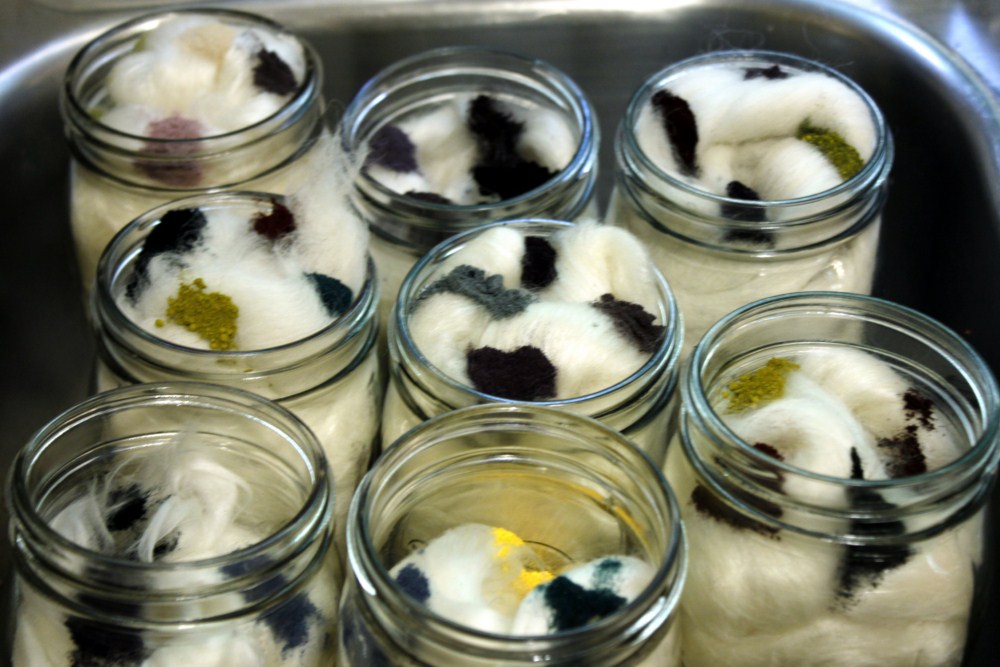
Looking for an interesting way to dye yarn?   This is an easy "Do It Yourself" way to dye using the heat of the sun.  Each skein will be unique, the colours will vary in each batch, and the colour will sometimes be solid or more variegated, this is not a precise colour method of dyeing.

First here is what you need:
black plastic garbage bags
large mason jars (also gallon freezer ziploc bags will work but it’s not quite as easy to fill)
citric acid or white vinegar
acid dyes
protein fibre(wool, locks, silk)
Mason Jars
large measuring cup for pouring water into jars
plastic spoon or measuring spoon for dye
wooden skewers


Once you have everything ready....start with filling a couple large dye pots with water and a few tablespoons of citric acid then bring to a boil.  Measure out your fibre, usually 2-4 oz bundles is a good size(to fit in a mason jar) and soak these bundles in water.

Dyes


Next add dye to your  mason jars and then add your 2-4 oz. bundle of either wool or locks...again amount will depend on the thickness of the fibre you are using, i.e. you could put more silk in a jar than wool.  Adjust your dye to the "bulk" of your fibre.

Dyes with Jars


Once the jar is filled with fibre pour the boiling water into the jars.  Using a measuring cup adds in your accuracy of getting the liquid into the jars.  Fill the jar about a 3/4 of the way (it will depend on how much fibre you have in the jar...so a bit more or less).  Once that has been done...push the bundle down using a skewer, if there is room at the top add more of your citric acid solution.
Yarn Solar Dyeing


Mason Jars filled with Yarn Solar Dyeing

Now put the lids on the jars and put the jars outside to set, do this when the sun is strongest!.  Put the jars in an area that gets the most direct sunlight.  If I need to “force” some extra heat, put a black plastic bag under the jars or if it isn't as hot as it was predicted that day you can put the jars IN a black plastic bag, and tie the top.. this will create some extra heat.
For Solar Dyeing to work you must reach at least 185 degrees F.  for at least 30 minutes...longer is better (3-4 hours). During this time the dye is adhering to the protein in the fibre.
When the dyes are set, the water-which was at first the color of your dye- will be clear, and your fiber will be dyed. Remember this technique creates a variance in colour in each skein and jar.    A way to create a tye dye look is to put your dry fibre in first then add the dye colour then more fibre more dye colour and repeat and at the end add your citric water.  The water will then filter down.
Solar Dyed Yarns

Solar Dyed Yarns Drying 
I was really pleased with how my yarns turned out!  The colours are great and it was quite simple!  I hope you find the instructions and pictures easy to follow.  I found the original article on Jazzturtle's How to Do it.

Monday, June 16, 2014

Felting, Fibre, Turkeys and Eggs

Another rainy day on the farm!  Which is good and bad....good for the gardens...bad for haying!

Rovings for spinning or felting
Today is just an update day....we have been shearing, shearing and shearing...and are almost done.  We did something a little different this time,  I kept some Alpaca fibre separate for those of you that enjoy felting.  It is something that I am quite enjoying.  You can felt in many different ways, such as Nuno felting...adding layers of fibre such as merino to silk to create a wearable items, i.e. a scarf, Needle felting, where you can create free standing objects ..animals are very common..."statues" you would almost say, Wet felting where you take wool and create sheets of felt and Resist felting where you use cardboard or plastic to create a form.  So as you see fibre doesn't just have to be made into a yarn for knitting and crocheting but it can be used in it's raw state as well to create other items.  I have both yarns and fibres.  We have Alpaca, Llama, Mohair, Merino, Wool, and Cashgora here for sale plus a few other specialty bits and pieces.

Turkeys from 2013
In other news the baby turkeys have arrived and we have more coming this week.  And although it is only June we do start to take orders for Thanksgiving as much as we don't want to rush the seasons, if you want a turkey you need to book early.  Last year we couldn't meet the demand!  Something else I want to mention and for those of you who have been here you know our turkeys when old enough get to be outside in a secure area in the sun and locked away at night.  It's a good turkey life!

We also have farm fresh eggs!  Nothing compares to farm fresh eggs!  The colour is brighter and the taste richer...enhanced.

We still have kids for sale...the boys have been wethered now.  We have a Nigora, Jake who is all black, and two Pygora/Nigerian Dwarf crosses, Louie and Jerry as well as Mick our Olde English Babydoll.

As always the store is open Thursday thru Sunday 10-5 pm or by appointment.

And don't forget if you are interested in booking a farm tour...give me a call at 705-778-2070

Monday, April 28, 2014

Knitting with Mohair and Mohair Blended Yarn

Happy Monday Everyone!

As you may have noticed there has been a theme to my last few posts.  I am hoping that by "teaching" everyone a few extra things with regards to different yarns and crafts that you may want to try your hand at creating!  I am looking outside and thinking I can't wait to be able to find a few hours; later on as Spring progresses and the farm "clean up" is done and sit outside and make a few things while enjoying the warmth of the sun.  Yes I am positive we WILL have warmth...soon!

Angora Kid
Also everything that I am showing you, you can find at the store.  Today I am talking about Mohair and knitting with it.  As you may remember...Mohair starts here with an Angora Goat just like our newest member of the family, Macy!  I have Mohair and Mohair blends in a beautiful array of colours!  Remember the store re-opens May 1st but you can certainly arrange a time to stop by just by calling 705-778-2070.

Here is an article by: The Halo Effect: Tricks and Tips for Knitting with Mohair
Posted by  on Jan 27, 2014 in Knitting 
The soft halo effect that mohair yarn creates can add instant softness and elegance to any knitting project, but there are a few things to keep in mind when knitting with mohair. Here are a few mohair tips, plus a few of our favorite mohair yarns and patterns to knit.
Delicate Mohair Yarn - on Craftsy

About mohair yarns

Mohair fiber comes from the angora goat (not to be confused with the angora rabbit that produces angora fiber). You’ve probably also noticed mohair labeled as kid mohair. This mohair comes from a kid — a baby goat — and is both finer and softer.

A few things to keep in mind when working with mohair:

Drape

Mohair’s soft texture allows it to drape beautifully. Keep it in mind for wraps, scarves or any other type of accessory that calls for a luxurious, elegant drape. You’ll see many examples of this in the patterns below.

Ripping mohair

Mistakes happen and sometimes we need to rip our project. Because of the long, delicate fibers, ripping mohair can be a challenge. Be sure to rip your work out slowly, gripping the yarn as close to the work as possible when you rip.

Texture

Mohair creates a beautiful drape, so why not leave it at that? Don’t go too insane with the texture of your stitches. You don’t need to add any fancy cables or special stitches to the design because mohair is already making a statement on its own.
If you’re a fan of lace knitting, consider mohair for your next lace project. Its airy texture goes hand in hand with a lot of beautiful lace patterns.

Mohair patterns to try

Mohair is versatile enough to work well in many different kinds of knits. Check out these Craftsy patterns for inspiration and ideas for your next mohair knitting project.
Sequined knit mohair lace vest
Photo via Craftsy member irissch

Sequined mohair lace vest

Have you ever worked with Artyarns before? The sequins and beads of their mohair is already attached, so you can knit up your project without worrying about attaching them as you go. This lace vest uses just two skeins of Artyarns Beaded Mohair and Sequins for a vest that’s loose but also slightly clingy because of the mohair fibers.

Friday, April 25, 2014

So ...You Think You Know Alpaca Yarn!?

Today I would like to talk about Alpaca Yarn.  It is a beautiful light weigh fibre with wonderful attributes, but there are some misconceptions, so to address this I am posting an article from "Knit Picks" that gives a nice brief history on the animals and on the fibre/yarn.
In the article it talks about blending the yarn for larger scaled knitted items.  The store offers you all that is needed to start knitting, from knitting needles to Alpaca, Merino, Mohair yarns.

The Elmlea Farm Store reopens on May 1st, 2014!  If you would like to get started on any project sooner or need fresh eggs please feel free to call me to arrange a time to drop by, the number is
705-778-2070.
Enjoy your weekend!

Alpaca
Hailing from South America, the alpaca belongs to the camelid family that also includes camels, llamas, guanacos and vicunas. They are a docile breed whose fleece spins into luxurious yarns. More than three quarters of the world’s alpaca population resides in Peru.1 In centuries past, the alpaca was an incredibly valuable animal, even more so than precious gems! Clothing created with alpaca was restricted for use by royalty. The alpaca has been domesticated and is treated as one of Peru’s national treasures. England has the double decker bus, the U.S. has Mt. Rushmore, and Peru has their alpacas. What a diverse definition of treasure!
Alpaca fleece is a “protein fiber”. This doesn’t mean knitting with it will make you stronger, it merely indicates that the fiber comes from an animal- namely, the alpaca. Alpaca fiber is strong, warm, and comfortable. Each fiber is hollow which makes it incredibly lightweight. Even the most delicate alpaca garments are warm for this reason. Perhaps alpaca’s greatest feature is that it can be worn next to the skin comfortably. The explanation for this is the behavior of the scales on the exterior of the fiber itself. They all lie flat in the same direction, making for a smooth surface. Less expensive than cashmere and with the strength of mohair, alpaca is highly desirable and functional. As with most natural fibers, alpaca needs to be handled with care when it comes to water exposure. Be sure to read and heed the washing instructions on your yarn or sweater.
While there are 2 breeds of alpaca, Huacaya and Suri, the former makes up a whopping 95% of the population.2 Differences between the two are numerous and as you may have guessed from the percentages, the Suri is harder to come by. Suri qualities include fleece that grows downward like human hair in wavy or curly locks with a silky texture. Huacaya fleece is coarser and grows straight outwards, at a right angle to the skin of the alpaca.
YES SURI, BABY, YOU’RE SUPERFINE!
When alpaca fiber is processed, it is evaluated and sorted into one of several categories based on its micron count (in layman’s terms: the softness quotient). Micron count is a technical measurement determined by studying a sample of alpaca fleece and calculating the average diameter of the shaft of each fiber. Baby alpaca might have a micron count in the high teens whereas superfine alpaca would fall in the mid-twenties. The lower the number, the finer the fiber. *Please note that baby alpaca is a classification group, meaning it doesn’t always come from young alpacas. It merely refers to any fibers from an alpaca’s fleece that fall within said micron count. While fibers become coarser as an alpaca ages, it is possible for older alpacas to continue to produce fibers that fall in the baby alpaca micron count range.
Yarn Classification
Average Micron Count
Average Fiber Length
Baby (finest)
21-23
>=64mm. (2½ in.)
Superfine
25-26.5
>=65mm. (2½ in.)
Suri
26-27
>=68mm. (2¾ in.)
Yarns sold by Knit Picks fall within these measurements.
If all of this jargon confuses you, then you might relate better to the methods used by Peruvian women who hand sort all of the fibers and determine their classification based on how they actually feel.3 The finest and softest feeling fibers are tagged as baby alpaca, and so on for fine and superfine yarns. Fiber from various parts of the animal can have different feels.
SMOOTH OPERATOR
Knitted garments made of alpaca have some interesting properties. You should know that alpaca yarn is pretty stubborn when it comes to elasticity. It’s not that it won’t give, it actually has a tendency to be too generous. If you knit dense stitches and patterns or hang heavy embellishments on it, it will become distorted with no hopes of regaining its youthful figure. This is due to the aforementioned smoothness of the fibers. Since the scales lie flat in the same direction, the plies or strands of an alpaca yarn slide past each other instead of clinging and gravity can take its toll on the fabric. Gravity, as we know, can sometimes cause an undesirable elongating effect. So make those 100% alpaca projects light and airy, or use a blend for greater resilience and elasticity.
Speaking of which, all blends happen for a reason. There are ways to make alpaca yarn work for every project and that is by blending it with complimentary fibers. Blended yarns are not created arbitrarily. Wool, for instance, is a highly crimped fiber and therefore offers some elasticity. Since alpaca fibers contain only shallow waves, mixing in some wool makes an otherwise unyielding yarn a little more forgiving.

1“A Shaggy Business” The Economist. Vol. 377, Issue 8455, p. 38. 12/3/2005.
2Quiggle, Charlotte. “Alpaca: An Ancient Luxury” Interweave Knits. Fall 2000.
3Lavan, Cindy. “Evaluating Alpaca Fleece” AlpacaNation – Alpaca Industry’s Central Marketplace. June 2002. http://www.alpacanation.com/articles/AlpacaFuture_Oct02.asp

Friday, April 11, 2014

Spring Yarns, and Rovings and Batts Oh My!

Another lovely day!  The animals are out and about playing in the sun.  Only 3 more goats to shear, then on to sheep and finally Alpacas and Llamas!

Hand Painted Yarn
Today's sun makes a person wish for flowers!  Still no flowers but I do have beautiful colours in yarn!  I will have yarns, roving and batts with me in Maynooth tomorrow for those of you who want to create your own! And for those of you who are looking to purchase something already made I will have hand crafted hats,shawls, scarves both knit and silk and of course I will have socks and insoles.  Any of these items would be a nice Easter gift, especially with some of the colours!

Mohair blended yarn

Alpaca Yarn

Hand dyed Yarn

I will be in Maynooth tomorrow, Saturday April 12, 2014 at the Community Center from 10-4. I do not have debit at this time but remember I take Visa and Mastercard which makes things so much easier! 

Also the store will reopen on May 1, 2014!  That is exciting news!  So it will be back to Thursday thru Sunday 10-5!  Really looking forward to that!

Monday, February 10, 2014

Elmlea Farm Store Products on Esty!

Happy Monday All!

Just updated the Esty Store for Elmlea Farm!  Here is a sampling of the yarns available...Merino, Mohair, Wool, and various blends of the these, hand spun, hand painted 2 ply, 3 ply...wonderful variety if colours pricing from $ 12- $22.

Remember I will be in Maynooth on Saturday, February 15th from 10-4 pm at the library.  I now take Visa and Mastercard as well as cash...sorry no debit cards at this time. 

We had visitors today viewing our animals.  Always nice to be told how friendly everyone is...Patrick, Lucy, Widget and Jill certainly know how to make you welcome, of course babies always make an impression!


70 Mohair, 30 Nylon
75 Mohair, 25 Wool
Hand painted 75% Mohair, 25% wool
Hand Dyed, Hand Spun 100% Merino
100% Merino Lace
100 % Wool Hand Painted
100% Wool